

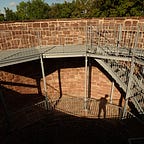

The tower looked sturdy. Its outer wall was thick; at least a metre in width I guessed while walking through the gateway into its interior – a round room, roofless. Some debris laid on the ground and there was a pit as if other people had lit a fire many months, perhaps even a year ago. A metal construction led two floors upward yet made an impression rather shiny. For there was not any of the usual rust eating away the material or organic life, lichen and mosses, residing on the fence and the beams.
Research prior had made me aware that the metal structure was a viewing platform. This platform had been built fairly recently and the tower been partially refurbished. Compared to the surrounding – nettles sprawling wild in the courtyard below, a grapevine snail clinging to stonework, shrubs and trees pushing their roots through the cracks slowly but ever so steadily – the tower indeed appeared as if all its many blocks chiselled from red sandstone had been erected just yesterday.


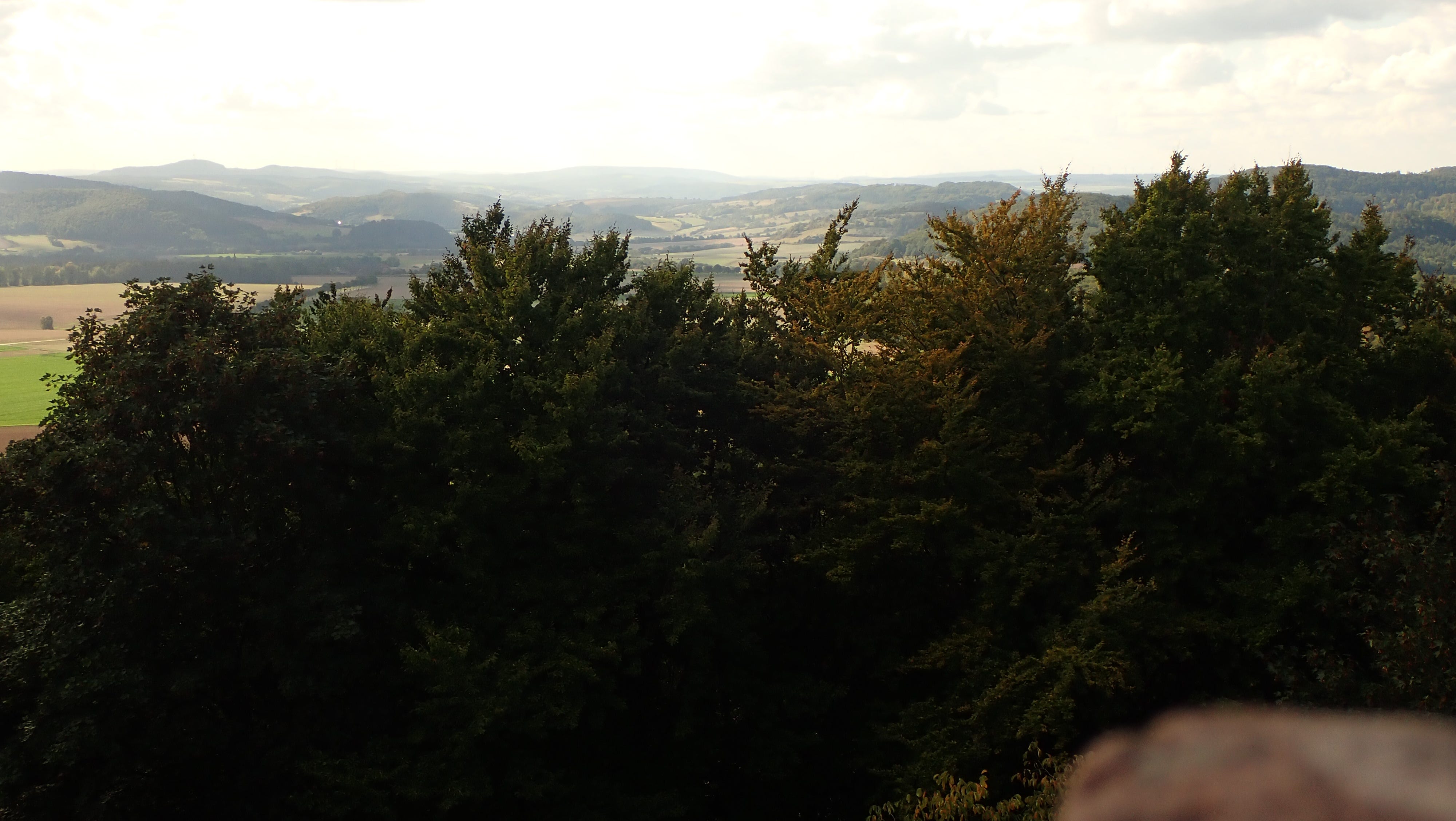
My visit coincided with a Sunday afternoon and surprisingly enough, there were not any other people around. This circumstance was one of fortune since I do enjoy having a place to myself. To let the aura of the castle encapsulate me undistractedly. To be able to stand still and revive medieval times in front of my inner eye and senses. Such as, I could listen to the voices of the guards marching on the upper floor of the tower. Or observe servants hang washing out on lines spanning across the 30 metre yard. I admired vegetables sprout from soil where the nettles grow today. Back then, even the trees might have been trimmed back to enhance a 360 degrees view into and around the surrounding landscape. Undulating hill country blanketed in deciduous greens and valleys that carried fertile, black, periglacially derived Tschernosem soils. Soils that developed under a tundric, continental climate some 9000 years ago. Long before civilisation thought about building castles and at a stage of societal evolution when humans here where hunting and gathering, living under the overhangs and preaching in the limestone caves of local heights. Or just occasionally passed by.
Fast forward into the Middle Ages: Around 1000 years ago, the structure was not just any tower but a Bergfried that belonged to the layout of this castle established by earl Siegfried IV. The initial purpose of the building was to protect an abbey sited in the lowlands. This abbey still exists to the southwest of the tower and offers a service at 10 AM every Sunday morning. However, since the abbey does not required formal protection from a castle anymore, at least not from this particular castle, former militant grandeur is now fading away. Only the tower is maintained to resist the effects of weathering and erosion, time and the elements. And what a shame if it was not, for the views are exquisite.
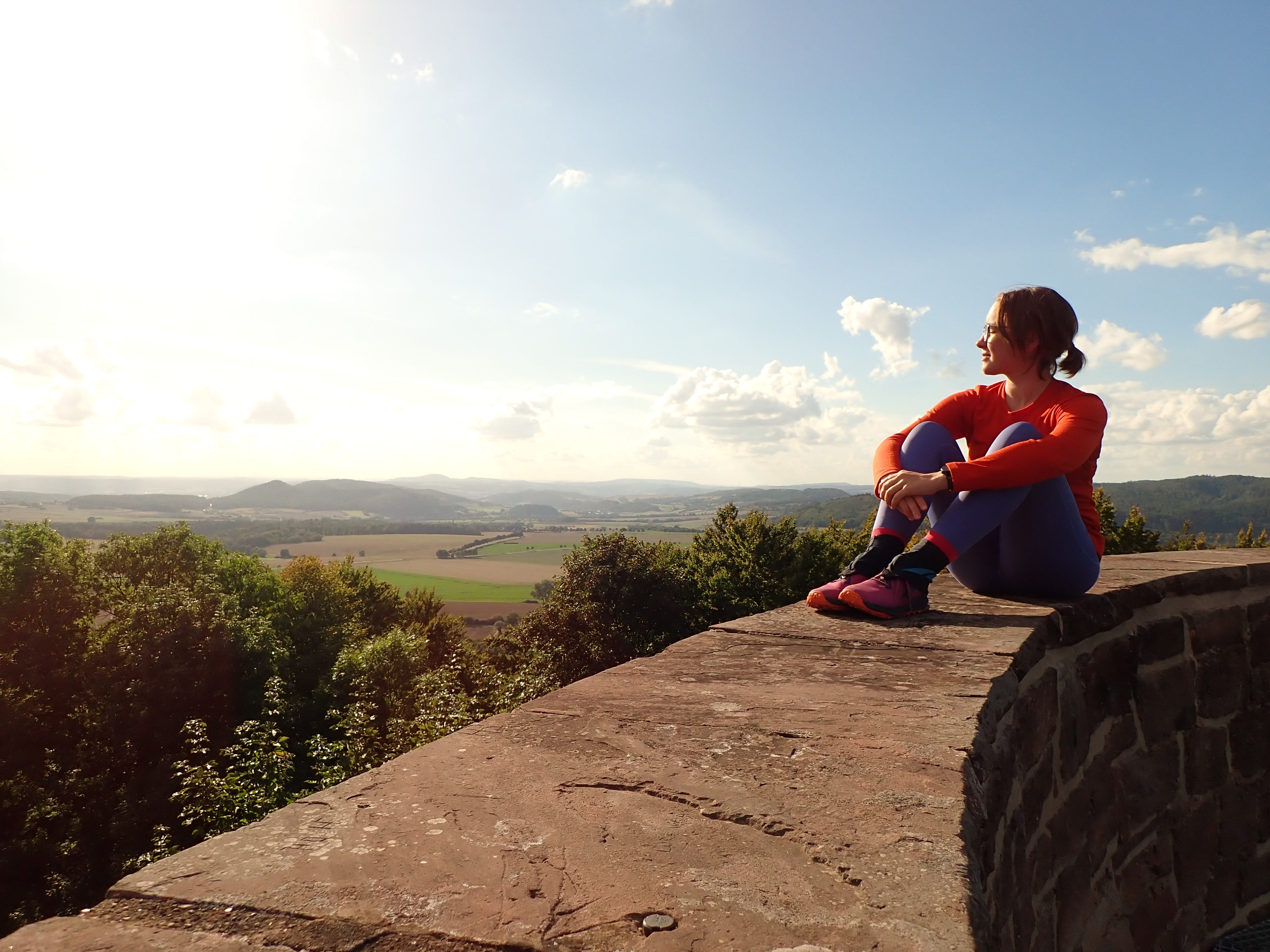
So I climbed to the top of the circular wall, stretched out my legs in front of me, hugged my knees tight, and sat still motionlessly. I let my eyes wander without any particular focus. Sometimes my vision might have caught the flight of a raven passing by or been bedazzled by the interplay of shadows streaming past and across the landscape. The clouds raced fast, driven forward by a strong autumn wind. This open consciousness of getting lost is what delights me most when I am outdoors. It is this sensation of taking in without having to concentrate to deeply. To be fully present and immersed in whatever happens, in whatever meanders through the stream of consciousness.


How easy it was to immerse up there on the tower; to simply sit on top of the walls of a thousand years old castle.
How could this be so straight-forward, I wondered, whereas my life oftentimes feels so heavy? Heavy for the fact that I force myself to find meaning and purpose, somehow and better sooner than later. I suspect, this rush is somewhat related to that I am in my fourth year of unemployment. For the first three of these years, I had different concerns due to my general life and health situation. Meaning: I was focused on surviving. In May this year, I attempted to be a cowgirl in the Swiss Alps. However, the undertaking failed and cut through my psyche as a clear statement of how far I could venture. Where my boundaries were and that the rules of my previously so adventurous life do not apply anymore to my present situation. The game of life has changed direction – obviously. I am practising to adjust accordingly whilst at the same time, seemingly put myself under a lot of pressure.
Do not get me wrong: Being able to live life again is the greatest gift I could have ever achieved. Living instead of only existing, in fact, was the dearest of my wishes. If wish is the right term. After all the word wish might actually be unsuitable to fully portray how hard I have worked to get to the current stage: speaking again, going grocery shopping again, sleeping safely again, being pain-free many times a day again, walking up a hill joyously again. In short: I am able to experience life in a way that is worthwhile and also includes a certain degree of wellbeing. Again.
If there was not this pressing urge to regain meaning and purpose. Or am I just telling myself so by using an intricate psychological mechanism to state that living life in the ways I do presently was meaningless? Saying that such life was not enough would surely be a very underacknowledging attitude toward the essence of what life is.
In one of my favourite books, Yes to Life: In Spite of Everything (1946/2020), the author, psychologist Viktor Frankl, writes that finding meaning in life is threefold affair.
Activity can create meaning and perhaps finding purpose through doing is what most people in the Western world are very familiar with. Then there is meaning through Love which I feel may not be hugely uncommon to many of us here in the Substack world. Love for others of our own species, love for all living beings, love for the wilderness as a source of meaning is powerful. And lastly, what about Suffering?
Is there meaning to be found in going through profound experiences of physical, emotional and/or spiritual pain? Experiences so severe that one´s life will be changed forever, never be the same again, taking a new twist without prior consultation? Due to Frankl, this is so. For he must know after having survived four different concentration camps in the Nazi regime. Frankl made it through the ordeal; however his mother, his brother, and his wife did not. They all were murdered. Reading Yes to Life therefore is as powerful as it is thought-provoking. Having Frankl state that he found meaning in the experience of surviving four different concentration camps is striking. Comprehension is possible only after letting his words sink in for a while. Then, it may become obvious that there indeed is meaning to be found in suffering. So much so that excavating this meaning is, perhaps, the sole way to actually deal with a severe situation during the experience as well as in its aftermath. Frankl writes:
True suffering of an authentic fate is an achievement, and, indeed, is the highest possible achievement.
Frankl´s quote is one that I carry with me dearly. Like when I feel the urge to justify my circumstances; why things are as they are. Why I behave as I behave. When I doubt myself; when everyone else in this world seems to overtake me, race past just so, I remind myself of what has happened. Silently, kindly, calmly – I know what I have been through and I do not have to lay it out to others in all its details every time, but instead find steadiness in reassuring myself. Suffering by now I believe, I have learnt how to handle. It is the next step which I struggle to appreciate. The one that appears after having survived. The one that awaits after leaving the cave of existence and re-entering the stage of life. This so very essential step of turning survival around, of breaking through the cocoon, of completing a life/death/life cycle.
At the beginning of this transformation, I often struggled with letting go of expectations. All those mental concepts that my upbringing, education, and society after all had carved into my behaviour. Such as that I could expect a happy life, a healthy life, a wholly decorated life as a successful scientist. This is what I had been striving for, working hard even if mostly unconsciously. It was life itself that after 31 years then told me its mechanisms to operate in very different ways. What does life expect of me?, was the question I should have asked. Uh, and those expectations reached high and low at the same time. Brought my insights to new heights while I travelled to the interface of extinction. For life demands of me to break through the cycle of transgenerational trauma, to unit body with mind, to celebrate my feminine sides, to return to natural rhythms, to embrace the dance of a wildish soul in between the poles of duality.
The minutes passed. Clouds skid across the sky. The sun graced me with her warming radiation. I could have sat on that wall of the castle tower many moments longer. Indulge in what felt so comfortable, so natural, so freeingly light: allowing presence to wash over and stream through me, taking a bath in the swells of the moment. Watching the leaves of the trees sway in the wind. Autumn was greeting me and by simply sitting there, I came to acknowledge his existence. The seasons are changing. Nature´s rhythm flows on and could it be that on this late Sunday afternoon she, nature herself, offered me an answer?


Her words where a whisper just. But since I was silent, unoccupied, still, I sensed her voice and listened to her wisdom:
Experiencing beauty can make life meaningful.
Having felt into the essence of this sentence for a couple of days, I am certain: This is what I am supposed to be doing or rather experiencing. It strikes me – again and again – how universally applicable the mechanisms of metamorphosis appear to be for the quote is one of Viktor Frankl´s. Likely, the words could have been written by many others, too. And they are, paraphrased perhaps, yet carrying a similar vibration. In that experiencing the beauty of life is a fully justified reason for one’s existence. One that can keep a person enduring suffering. One that can also help a person to re-enter the vitality and vibrancy of life. This beauty does not ask to be luxurious and large. Rather it appears in the petal of a flower, the sailing of leaves through the currents of air, the smile of another human, the silky touch of the fur of a cat…
With the arrival of autumn, I can make out my inner seasons change. From survival to finding purpose and love for life in the immersion of beauty? Could it be that life expects me not to skip this bit? To fall in love (again) with life´s subtle yet beautiful simplicities… and to grant myself permission to do so?
To root in the now. To not let my mind create a purpose paradox unnecessarily. To let time pass by as if an eternity was available to me sitting there on that one thousand years old wall of a medieval tower.
To simply be.
Here.
It is with deep gratitude that I wish to acknowledge your presence and having read or listened to this essay. May some of my words have resonated and provided you with whatever you were seeking for, hoping to find or curious about.
To finish this session of with, I like to pass on another two quotes from the Frankl book:
Living itself means nothing other than being questioned; our whole act of being is nothing more than responding to – of being responsible towards – life. From this mental standpoint nothing can scare us anymore, no future, no apparent sense of futility. Because now the present is everything, as it holds the eternally new question of life for us.
Whether a life is fulfilled does not depend on how great one´s radius of action is but rather only on whether the circle is fully filled out.
Sending a wind beat to wherever you are today
Enna


